Yesterday (Thursday, November 5th) two earthquakes hit Taiwan. They hit in the evening, a few hours apart. Although they didn’t cause much damage, experiencing them was definitely a new thing for us. People here are a little worried about our luck because of the typhoon, my hospital stay, us losing our camera and now the two earthquakes. :)
http://www.upi.com/Top_News/International/2009/11/06/Two-earthquakes-hit-Taiwan-in-two-hours/UPI-88741257487059/
Friday, November 6, 2009

BOAT BURNING AND ISLAND EXPLORING
A few weekends ago now, Phil and I headed down to the relatively small city of Donggang to meet up with some other foreign English teachers for the city’s Boat Burning Festival. This festival only takes place once every three years, so we were pretty excited about being able to see it.
We didn’t arrive in Donggang until about 11:00 pm on Friday, October 16th. We had to take a train, a bus and a taxi to make it to the city and get to our hotel. The hotel we stayed at was...how do I explain it...one of those where we were just really hoping we walked away from it without having lice. :) It was pretty cheap, though, so that was nice.
The husband and wife couple who owned the hotel didn’t speak any English, but they guessed correctly why we were visiting and brought us and the other foreign English teachers to the temple where the Boat Burning Festival started. We arrived at the temple around midnight and we were thinking (and had been told) that the event would be over by 3:00 am.
When we arrived at the temple we saw the beautiful boat. This boat’s only purpose was to be burned. About 30,000 USD were spent building and decorating it. The boat was burned as an offering to the god they believe watches over the waters. The hope is this offering will bring three years of good luck to all who partake in it.


The guy on the phone was the taxi driver who brought us from the water back to our hotel earlier that morning. He had gotten my phone number from the owners of the hotel. He was calling because he had our camera. He told the girls he was in Kaohsiung City and would come back to Donggang to give us our camera but we had to pay him 5,000-10,000 NT dollars (about 155-315 USD). We thought it was funny he gave us a range...we wondered if he honestly thought we’d choose to pay him 10,000 NT dollars. :)
We only paid about 6,000 NT for our camera (the month before), so we had the poor girls tell him that we didn’t feel comfortable giving him that much. He wouldn’t budge. The girls tried to barter for us, but all their effort didn’t change his mind. We told the girls it was okay, he could have it. They wanted to call the police for us...they were very sweet, but we weren’t up for the drama.
We went to Seven-Eleven and bought a disposable camera and headed to catch the ferry. On the way there, we randomly saw our taxi driver who was in fact NOT in Kaohsiung City. :) We decided we’d be willing to pay him 1,000 NT (about 30 USD) for our camera. We went to talk to him and showed him the 1,000 NT...he seemed to recognize us right away, but after he realized the amount we were willing to pay, he started to “pay dumb”. Without anyone to interpret for us, we were stuck making the action of taking a picture and pointing at the money while he just shook his head.
We let it go and said goodbye to our camera for good. (The pictures above are from the other foreign English teachers who were with us at the boat burning. The pictures below are digital pictures of the pictures we got developed from our disposable camera....people don’t have scanners here so this was the only way we could get them on the computer.) We decided if we had to lose our camera, having it held for ransom was much more interesting/fun than just forgetting it somewhere! :)
.jpg)


We didn’t arrive in Donggang until about 11:00 pm on Friday, October 16th. We had to take a train, a bus and a taxi to make it to the city and get to our hotel. The hotel we stayed at was...how do I explain it...one of those where we were just really hoping we walked away from it without having lice. :) It was pretty cheap, though, so that was nice.
The husband and wife couple who owned the hotel didn’t speak any English, but they guessed correctly why we were visiting and brought us and the other foreign English teachers to the temple where the Boat Burning Festival started. We arrived at the temple around midnight and we were thinking (and had been told) that the event would be over by 3:00 am.
When we arrived at the temple we saw the beautiful boat. This boat’s only purpose was to be burned. About 30,000 USD were spent building and decorating it. The boat was burned as an offering to the god they believe watches over the waters. The hope is this offering will bring three years of good luck to all who partake in it.


A little after we arrived at the temple, many different dances and rituals began. Around 1:00 am they started moving the boat from the temple to the water. The distance between the temple and the water was not short...I would guess it was about a mile. The boat was followed by many different characters, symbolizing gods. The streets were absolutely packed as we followed the boat to the water. Fireworks and firecrackers were constantly going off. All the people, all the noise and all the lights were overwhelming at times. It was definitely like nothing we had experienced before.
The boat arrived at the water around 2:30 am. We were having a great time, but we were also ready to see the boat burn and go to bed...that didn’t happen for awhile. About two and a half hours were spent loading the boat with TONS of ghost money (a special paper that is often burned here as an offering to gods or for relatives who have passed away) and many other things.
The boat arrived at the water around 2:30 am. We were having a great time, but we were also ready to see the boat burn and go to bed...that didn’t happen for awhile. About two and a half hours were spent loading the boat with TONS of ghost money (a special paper that is often burned here as an offering to gods or for relatives who have passed away) and many other things.

The hour right before the boat burned was spent getting the boat’s sails setup and adding final decorations. At this point we were very tired. Because of how exhausted we all were, the process of adding final decorations to the boat felt like a game of hangman that had gone too far...you know, like one of those hangman games when you really don’t want the other person to lose so you keep adding things to the poor guy “Oh, he can have three hairs and we’ll give him some sunglasses.”
Finally, around 6:00 am, firecrackers were lit to ignite the ghost money that the boat was on and we saw the boat burn as the sun was rising. It was a very unique experience! (Visit this link if you’re interested in finding out more about the festival: http://online.wsj.com/article/SB125315178060618481.html)


From the water, we took a taxi back to our hotel and slept for a few hours. When we got up, we were planning on taking a 25 minute ferry ride from Donggang to a tiny offshore island called Little Liuchiu Island, but before we got to that we received a random call on my cell phone. It was a guy who only spoke Chinese. We didn’t know what to do at first, but ended up asking three junior high girls who knew a little English to talk to him and interpret for us...humbling.
The guy on the phone was the taxi driver who brought us from the water back to our hotel earlier that morning. He had gotten my phone number from the owners of the hotel. He was calling because he had our camera. He told the girls he was in Kaohsiung City and would come back to Donggang to give us our camera but we had to pay him 5,000-10,000 NT dollars (about 155-315 USD). We thought it was funny he gave us a range...we wondered if he honestly thought we’d choose to pay him 10,000 NT dollars. :)
We only paid about 6,000 NT for our camera (the month before), so we had the poor girls tell him that we didn’t feel comfortable giving him that much. He wouldn’t budge. The girls tried to barter for us, but all their effort didn’t change his mind. We told the girls it was okay, he could have it. They wanted to call the police for us...they were very sweet, but we weren’t up for the drama.
We went to Seven-Eleven and bought a disposable camera and headed to catch the ferry. On the way there, we randomly saw our taxi driver who was in fact NOT in Kaohsiung City. :) We decided we’d be willing to pay him 1,000 NT (about 30 USD) for our camera. We went to talk to him and showed him the 1,000 NT...he seemed to recognize us right away, but after he realized the amount we were willing to pay, he started to “pay dumb”. Without anyone to interpret for us, we were stuck making the action of taking a picture and pointing at the money while he just shook his head.
We let it go and said goodbye to our camera for good. (The pictures above are from the other foreign English teachers who were with us at the boat burning. The pictures below are digital pictures of the pictures we got developed from our disposable camera....people don’t have scanners here so this was the only way we could get them on the computer.) We decided if we had to lose our camera, having it held for ransom was much more interesting/fun than just forgetting it somewhere! :)
.jpg)
After we put our camera drama to rest we headed to Little Liuchiu Island. This place was great! We were there from Saturday afternoon until the late morning on Sunday. We rented a scooter for that entire time for about 12 USD...dirt cheap! (No one cared that we didn’t have scooter licenses.) As you’ve probably already guessed, Phil was in heaven! :)

As we were checking out some of the island’s main attractions (small caves, short hikes, scenic overlooks), a local English teacher on the island spotted us and devoted his entire afternoon and evening to being our tour guide. (This helpful, friendly, welcoming attitude is much more characteristic of the Taiwanese people than the way our taxi driver acted.) He was very nice and although we were hesitant to have him show us around at first, we ended up really enjoying his company.


We spent the night at a beautiful little campground/resort. We were able to rent a tent and sleeping bags and ended up camping right by the ocean. It was great!

What a weekend! :)
Monday, October 26, 2009
OUR LIVES AT SCHOOL
This is the entry we’ve avoided writing for some time now. Not because things aren’t going well at school...just because, like it was mentioned before, there’s so much to tell and explain that writing this entry feels like an overwhelming assignment. With that being said, we’re probably just going to give you a general idea of what our lives at school are like...the “big picture”...not all the great, confusing, fun, frustrating, cute, funny moment since we’ve started working.
There are many things about the way schools are run here that are similar to the way they’re run in the States. On the other hand, there are many, many things that are very different. Some of these differences were apparent right away. Some of these differences we felt, but didn’t understand or couldn’t explain at first. Of course, they’re still difference we’re trying to sort out to this day.
Because of these differences, cultural differences in general and the language barrier, it took us a little longer than we expected to get into the swing of things at school and really feel comfortable with what was expected of us. During this time, we experienced some frustrations, but mostly humorous realizations about ourselves and/or the Taiwanese culture. At this point, thankfully, our duties at school are pretty clear.
Annalicia’s School
My school building/campus seems very large to me. The interesting thing about this is that its space is not utilized. For example, at one point this school had ten different first grade classes. Currently, it only has four. People here have told me that this decrease in population is happening throughout the island and it concerns the Taiwanese government. So, unlike China, the Taiwanese government encourages families to have more than one child. They attribute this decrease in population to less women getting married and having children compared to trends in the past. Also, couples are not having as many children as they commonly did before. This decision, I’ve been told, is often due to financial concerns. (Most Taiwanese parents cover all of a child’s expenses all way through college for sure and oftentimes even after they get jobs and are married.)
I find my school’s facilities and its surroundings very beautiful. My favorite thing is when butterflies or birds fly into my office. It probably happens about once a week. I seem to be the only one who notices them flying around.
Wildlife in the school is different from what I’m used to...most of the time it’s a pleasant surprise. There have been times, however, it hasn’t been so great. For example, earlier this fall there was a cobra in the lower level of my school. The police had to be called and that section of the school had to be closed off until they were sure the snake was gone...it took a few days.


(The front of my school)


(The mountains are there though! I took this picture one morning right after it rained.)

(The back of my school)


(Student Activity Center)

(This is the track I run on.)


(My office)


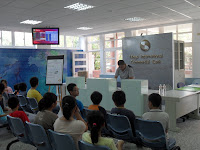


(My classroom)
 (My office)


 (My co-teachers)
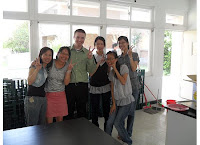 (A few other staff members)


--Although there’s no recess after lunch, at the elementary level there are multiple scheduled breaks throughout the day for students to run around outside. Since the classrooms exit right into the outdoors and it stays nice here all year round, it works out nice for them to allow students some “running around time” this way.
--Elementary students who go to public schools don’t go to school all day, everyday. Each grade has different days they go home early and different days they stay at school all day. Wednesdays are the only days that all grades go home after lunch. Thursdays are the only days that all grades are in school a full day. This schedule is consistent throughout the island (the schedule is decided on by the government, not individual schools). Once they get into junior high, though, students have to be in school from 7:15-7:30 am to 5:00 pm (or later) everyday.
--Students here are under pretty extreme pressure to demonstrate high academic performance. Most students of all ages go to what they call “bushiban” or ”cram school” after regular school and on Saturdays and sometimes Sundays. For example, a student might go to one cram school on Monday and Wednesday evenings that focuses on English. He might go to another one on Tuesday and Thursday evenings that focuses on helping him do well on a specific test. He might spend Saturdays going to one that helps him learn an instrument. Cram schools are not only for students preschool aged through 12th grade, some college aged students utilize them as well.
--Exams here are very crucial...they can determine a lot about what a person’s path in life will be. When students are in 9th grade, they take a very important test. How they do on this test determines what senior high schools they can attend. What senior high school a student goes to often determines whether or not a student is able to go to college and/or attend other postgraduate forms of education. Depending on the profession a person wants to work towards, there are many other very important test he/she must take. These tests are so significant that some people will quit regular school and/or their jobs all together in order to attend a cram school full time (sometimes for months or a year or more) to study for the their upcoming test.
--White Out is really big here...it seems like most kids even have it.
--In general, it doesn’t seem like people plan ahead as much at school here as people do in the States. For example, teaching schedules weren’t put together until the Friday before the first day of school. After school started things were still being switched around. This surprised us because usually in the U.S. a teacher knows a lot about what his/her schedule will look like for the upcoming school year before school’s out for the summer.
--The way most people here go about problem solving in their everyday lives is quite different from what we’re used to in the States. At orientation we were told by a local Taiwanese person that when Western people notice a problem, they usually go right at it and attack its source. On the other hand, Taiwanese people often “dance” around it for awhile until they eventually get to the root cause. In our experience, we’d definitely say that is true.
--From what we’ve noticed, we feel that planning and organizing in Taiwan often works in the opposite direction of what we’re accustom to. For example, a person here might feel comfortable starting off a planning process by figuring out the details of an event (buying posters, discussing decorations, etc...) before figuring out the overall goal.
--Elementary students always take off their shoes before they enter their classrooms. Instead of wearing shoes in their classrooms, they wear “slippers”. We would consider these “slippers” to be more like flip-flops.
--Schools here often become known for something. For example, if a school does well at a music competition for many years in a row, students might start going to that particular school for an education that really focuses on music.
--Principals in Taiwan don’t seem to play as active of a role in the students’ direct education as principals in the U.S. do. Their major role seems to be doing more of making sure their schools look good in the public’s eyes and getting their schools funding for different things. Someone here told us they almost act as politicians for their schools.
--In the elementary schools there aren’t public restrooms. Instead, bathrooms are attached to every classroom or office. Each restroom at my (Annalicia’s) school has one squat toilet, one western toilet and a few urinals. As I mentioned in an entry before, this setup can feel slightly awkward for me because I’m used to men and women’s restroom facilities being separate. I still haven’t quite figured out what the etiquette...I don’t know if that’s the right word...for using the restroom at my school is yet. So, I just avoid it at all costs! :)
--On average, my (Annalicia’s) week at school usually include at least three, sometimes four or five unexpected “Tea Times”. These are always pleasant surprises. The reasons for these “Tea Times” are not always clear to me. Sometimes I think they’re just for fun, which I think is great! Sometimes I think they happen because someone shows up to visit or something like that.
--People here are taking H1N1 very seriously. We’ve been told this is because SARS hit Asian countries so bad...people here have a strong, unpleasant memory of pandemic influenza viruses. Anyone who enters my (Annalicia’s) school campus at any point during the day, must be screened for a fever and rub alcohol on their hands.
Wow...even giving you just the “big picture” turned into a novel.
There are many things about the way schools are run here that are similar to the way they’re run in the States. On the other hand, there are many, many things that are very different. Some of these differences were apparent right away. Some of these differences we felt, but didn’t understand or couldn’t explain at first. Of course, they’re still difference we’re trying to sort out to this day.
Because of these differences, cultural differences in general and the language barrier, it took us a little longer than we expected to get into the swing of things at school and really feel comfortable with what was expected of us. During this time, we experienced some frustrations, but mostly humorous realizations about ourselves and/or the Taiwanese culture. At this point, thankfully, our duties at school are pretty clear.
Annalicia’s School
My school building/campus seems very large to me. The interesting thing about this is that its space is not utilized. For example, at one point this school had ten different first grade classes. Currently, it only has four. People here have told me that this decrease in population is happening throughout the island and it concerns the Taiwanese government. So, unlike China, the Taiwanese government encourages families to have more than one child. They attribute this decrease in population to less women getting married and having children compared to trends in the past. Also, couples are not having as many children as they commonly did before. This decision, I’ve been told, is often due to financial concerns. (Most Taiwanese parents cover all of a child’s expenses all way through college for sure and oftentimes even after they get jobs and are married.)
I find my school’s facilities and its surroundings very beautiful. My favorite thing is when butterflies or birds fly into my office. It probably happens about once a week. I seem to be the only one who notices them flying around.
Wildlife in the school is different from what I’m used to...most of the time it’s a pleasant surprise. There have been times, however, it hasn’t been so great. For example, earlier this fall there was a cobra in the lower level of my school. The police had to be called and that section of the school had to be closed off until they were sure the snake was gone...it took a few days.


(The front of my school)


(This is the view I usually see looking out the back of my school...the humidity usually causes a haze that makes it hard to see the mountains.)

(The mountains are there though! I took this picture one morning right after it rained.)

(The back of my school)


(Student Activity Center)

(This is the track I run on.)


(My office)
My time at school is spent differently everyday. My major responsibilities so far have included teaching four first grade English lessons per week, helping with four second grade lessons per week, assisting with the development and implementation of Yunlin Elementary’s Daily English program, teaching a short English lesson to the teachers once a week (and a Pilates class to the teachers once per month) and helping with our English village. This week I was informed, though, that my responsibilities would change starting next week. I was told that parents are upset that I’m only teaching first and second grade English classes. So, I will continue to teach about eight English classes per week, but now I will teach a different grade level each week. This means I will see each class about once per month.
An English village is a section of the school that is built to look like different places, such as a bank, an airport, etc... Not many schools have English villages, only one or two in each county here it seems. The goal of an English village is to give students the opportunity to experience what it would be like to go to these places in an English speaking country. The English village at my school is brand new and the facilities are beautiful. We are preparing to open our English village to all 5th grade students in Yunlin County starting on November 25th.
An English village is a section of the school that is built to look like different places, such as a bank, an airport, etc... Not many schools have English villages, only one or two in each county here it seems. The goal of an English village is to give students the opportunity to experience what it would be like to go to these places in an English speaking country. The English village at my school is brand new and the facilities are beautiful. We are preparing to open our English village to all 5th grade students in Yunlin County starting on November 25th.


The people at my school tend to like to take a lot of pictures and video of me teaching...


My school is also really pushing the idea of all students and staff learning daily English phrases, hence our Daily English program. As a part of this program, I’ve been asked to do many audio recordings and video recordings. I found out a few weeks ago that some of these videos have been posted to You Tube for students to study at home. :) If you’d like to experience some of my high quality acting, you can click on the link below!
Phil’s School
My school is the newest school in Yunlin County (3 years old). The best way I can describe it is that it’s in the shape of a 3 story lower case “m”. I have my very own office with A/C, a real luxury! My classroom has A/C and the English Village I teach in has A/C. So no matter where I am I have the luxury of not sweating profusely. Annalicia is a little jealous :). My principal is very relaxed and easy going compared to other principals so being at this school is pretty great.
My school is the newest school in Yunlin County (3 years old). The best way I can describe it is that it’s in the shape of a 3 story lower case “m”. I have my very own office with A/C, a real luxury! My classroom has A/C and the English Village I teach in has A/C. So no matter where I am I have the luxury of not sweating profusely. Annalicia is a little jealous :). My principal is very relaxed and easy going compared to other principals so being at this school is pretty great.


(My classroom)
 (My office)
I teach 10 classes a week, five 7th grade and five 8th grade. My curriculum consists of the 9 units of the English Village. The 9 units are: Airport Information, Airport Check-In, Customs, Security, Airplane Cabin, Hotel, Living Room, Shopping Mall, and Restaurant. Basically what they want me to do is teach the kids phrases they will need to use when they are in those areas. So I come up with vocabulary, dialogue, and games to help the students learn the phrases for each unit.


I have three co-teachers that help me during my classes. None of them are actual teachers. One is a student teacher, one is a military guy, and the other was hired because she spoke English. The military guy is doing his military service by using his English ability to help schools with their English program. They are all very nice and helpful. Classroom management is the biggest issue I deal with here. It’s hard not being able to communicate fully with the students and having a “middle man” (my co-teachers) involved. Also, discipline is handled much differently here compared to in the States.
 (My co-teachers)
 (A few other staff members)
Interesting Things to Note
--Elementary schools have periods. So, even if students are in their classroom, being taught a lesson by their classroom teacher, everyone seems to follow the same schedule and break system. This is a little different than in the U.S. where in most cases, each classroom teacher creates his/her own schedule for his/her class.
--The bells here are more of an indication of transition versus a specific starting/ending time. For example, if students have a break, they don’t go back to their classroom early so they’re in their seats by the time the bell rings. Instead, once they hear the bell ring, they begin moving towards their classroom. Also, teachers don’t try to wrap up a lesson before the bell rings. Instead, they wait for the bell to indicate when their lesson should finish.
--It’s appropriate for students to call their teacher, “Teacher”. This is considered a title of respect, unlike in the U.S. where it is considered more of a job description.
--It’s appropriate for students to call their teachers by their first names as well. For example, most students call me (Annalicia) “Anna” (everyone here calls me that...it’s a lot easier to say) or what would be interpreted as “Anna Teacher”.
--One of my (Annalicia’s) students calls every adult who knows English, “Anna”. I have another student who calls every teacher, “Anna”. We (my co-teachers and I) are not sure if these two students think “Anna” is “teacher” in English. Regardless, we’ve tried to clear this up for the students, but we have not been successful...they’re still greeting adults with a big smile and saying, “Hi, Anna!” :)
--A lot of staff members call each other by their titles (as a sign of respect) while in school, instead of by their names (even if they’re friends).
--If a holiday lands on a weekday, school is closed, but to make it up everyone (staff and students) goes to school the following Saturday.
--There are no school buses. We think this is the case because things in Taiwan are very compact compared to the U.S. so everyone lives relatively very close to the school their children go to.
--There’s no main office at most schools. Instead, there are different offices scattered throughout the building.
--Almost every teacher has his/her own personal microphone system.
--In most elementary classrooms, there’s a small stage for teachers to stand on located directly below the chalkboard. (I (Annalicia) go to students’ homeroom to teach their English lessons and standing on this stage can feel very awkward for me. I’m considered a pretty tall person here. So, if I have heals on and I’m standing on the stage, my head goes above the top of the chalkboard in some of the classrooms... I often hit my head on their suspended TVs.) :)
--Students help with the cleaning and upkeep of the school for around 20 minutes each day.
--The bells here are more of an indication of transition versus a specific starting/ending time. For example, if students have a break, they don’t go back to their classroom early so they’re in their seats by the time the bell rings. Instead, once they hear the bell ring, they begin moving towards their classroom. Also, teachers don’t try to wrap up a lesson before the bell rings. Instead, they wait for the bell to indicate when their lesson should finish.
--It’s appropriate for students to call their teacher, “Teacher”. This is considered a title of respect, unlike in the U.S. where it is considered more of a job description.
--It’s appropriate for students to call their teachers by their first names as well. For example, most students call me (Annalicia) “Anna” (everyone here calls me that...it’s a lot easier to say) or what would be interpreted as “Anna Teacher”.
--One of my (Annalicia’s) students calls every adult who knows English, “Anna”. I have another student who calls every teacher, “Anna”. We (my co-teachers and I) are not sure if these two students think “Anna” is “teacher” in English. Regardless, we’ve tried to clear this up for the students, but we have not been successful...they’re still greeting adults with a big smile and saying, “Hi, Anna!” :)
--A lot of staff members call each other by their titles (as a sign of respect) while in school, instead of by their names (even if they’re friends).
--If a holiday lands on a weekday, school is closed, but to make it up everyone (staff and students) goes to school the following Saturday.
--There are no school buses. We think this is the case because things in Taiwan are very compact compared to the U.S. so everyone lives relatively very close to the school their children go to.
--There’s no main office at most schools. Instead, there are different offices scattered throughout the building.
--Almost every teacher has his/her own personal microphone system.
--In most elementary classrooms, there’s a small stage for teachers to stand on located directly below the chalkboard. (I (Annalicia) go to students’ homeroom to teach their English lessons and standing on this stage can feel very awkward for me. I’m considered a pretty tall person here. So, if I have heals on and I’m standing on the stage, my head goes above the top of the chalkboard in some of the classrooms... I often hit my head on their suspended TVs.) :)
--Students help with the cleaning and upkeep of the school for around 20 minutes each day.
--There’s no lunchroom. Students and teachers bring their own bowls, chopsticks and spoons and eat in their classrooms (the food is delivered there). They also clean all pots, pans, dishes and utensils up on their own.
--There are no lunch menus and there are no students or teachers who bring “cold lunches”. Everyone is simply expected to eat what is prepared for them.
--The school lunches usually consist of rice (sometimes it’s noodles or porridge), two vegetable dishes, one protein dish (meat, tofu or eggs) and soup. A few days a week the lunches will include fruit for dessert. The lunches here consist of virtually no processed/packaged food, unlike in the States. Also, no one (besides us at first) :) have drinks with their meals. Their soup usually takes the place of water.
--Once a week, the government requires all schools to have an all vegetarian meal in an effort to decrease CO2 levels.
--There are no vending machines in the schools.
--There is no teacher lounge, but each office has an area with a few couches. This is where we have “tea time” and there are always snacks out in this area too.
--The tap water here is not considered safe to drink. Stomach irritation caused by drinking the water is not typically an issue, it’s more a concern of general wellbeing...the Taiwanese people don’t trust the pipes that transport the water from the mountain streams to the cities. With this being said, there are no water fountains in our schools. Instead, people boil water in large teapots and fill up water bottles. There are also water filtering machines scattered throughout our buildings.
--Students often greet and bow to teachers when they start class and in the hallway.
--After lunch there’s no recess. Instead, students and teachers take naps. Staff members who don’t have to be in a classroom with students, check-out napping rooms for the entire school year! :)
--There are no lunch menus and there are no students or teachers who bring “cold lunches”. Everyone is simply expected to eat what is prepared for them.
--The school lunches usually consist of rice (sometimes it’s noodles or porridge), two vegetable dishes, one protein dish (meat, tofu or eggs) and soup. A few days a week the lunches will include fruit for dessert. The lunches here consist of virtually no processed/packaged food, unlike in the States. Also, no one (besides us at first) :) have drinks with their meals. Their soup usually takes the place of water.
--Once a week, the government requires all schools to have an all vegetarian meal in an effort to decrease CO2 levels.
--There are no vending machines in the schools.
--There is no teacher lounge, but each office has an area with a few couches. This is where we have “tea time” and there are always snacks out in this area too.
--The tap water here is not considered safe to drink. Stomach irritation caused by drinking the water is not typically an issue, it’s more a concern of general wellbeing...the Taiwanese people don’t trust the pipes that transport the water from the mountain streams to the cities. With this being said, there are no water fountains in our schools. Instead, people boil water in large teapots and fill up water bottles. There are also water filtering machines scattered throughout our buildings.
--Students often greet and bow to teachers when they start class and in the hallway.
--After lunch there’s no recess. Instead, students and teachers take naps. Staff members who don’t have to be in a classroom with students, check-out napping rooms for the entire school year! :)
--Although there’s no recess after lunch, at the elementary level there are multiple scheduled breaks throughout the day for students to run around outside. Since the classrooms exit right into the outdoors and it stays nice here all year round, it works out nice for them to allow students some “running around time” this way.
--Elementary students who go to public schools don’t go to school all day, everyday. Each grade has different days they go home early and different days they stay at school all day. Wednesdays are the only days that all grades go home after lunch. Thursdays are the only days that all grades are in school a full day. This schedule is consistent throughout the island (the schedule is decided on by the government, not individual schools). Once they get into junior high, though, students have to be in school from 7:15-7:30 am to 5:00 pm (or later) everyday.
--Students here are under pretty extreme pressure to demonstrate high academic performance. Most students of all ages go to what they call “bushiban” or ”cram school” after regular school and on Saturdays and sometimes Sundays. For example, a student might go to one cram school on Monday and Wednesday evenings that focuses on English. He might go to another one on Tuesday and Thursday evenings that focuses on helping him do well on a specific test. He might spend Saturdays going to one that helps him learn an instrument. Cram schools are not only for students preschool aged through 12th grade, some college aged students utilize them as well.
--Exams here are very crucial...they can determine a lot about what a person’s path in life will be. When students are in 9th grade, they take a very important test. How they do on this test determines what senior high schools they can attend. What senior high school a student goes to often determines whether or not a student is able to go to college and/or attend other postgraduate forms of education. Depending on the profession a person wants to work towards, there are many other very important test he/she must take. These tests are so significant that some people will quit regular school and/or their jobs all together in order to attend a cram school full time (sometimes for months or a year or more) to study for the their upcoming test.
--White Out is really big here...it seems like most kids even have it.
--In general, it doesn’t seem like people plan ahead as much at school here as people do in the States. For example, teaching schedules weren’t put together until the Friday before the first day of school. After school started things were still being switched around. This surprised us because usually in the U.S. a teacher knows a lot about what his/her schedule will look like for the upcoming school year before school’s out for the summer.
--The way most people here go about problem solving in their everyday lives is quite different from what we’re used to in the States. At orientation we were told by a local Taiwanese person that when Western people notice a problem, they usually go right at it and attack its source. On the other hand, Taiwanese people often “dance” around it for awhile until they eventually get to the root cause. In our experience, we’d definitely say that is true.
--From what we’ve noticed, we feel that planning and organizing in Taiwan often works in the opposite direction of what we’re accustom to. For example, a person here might feel comfortable starting off a planning process by figuring out the details of an event (buying posters, discussing decorations, etc...) before figuring out the overall goal.
--Elementary students always take off their shoes before they enter their classrooms. Instead of wearing shoes in their classrooms, they wear “slippers”. We would consider these “slippers” to be more like flip-flops.
--Schools here often become known for something. For example, if a school does well at a music competition for many years in a row, students might start going to that particular school for an education that really focuses on music.
--Principals in Taiwan don’t seem to play as active of a role in the students’ direct education as principals in the U.S. do. Their major role seems to be doing more of making sure their schools look good in the public’s eyes and getting their schools funding for different things. Someone here told us they almost act as politicians for their schools.
--In the elementary schools there aren’t public restrooms. Instead, bathrooms are attached to every classroom or office. Each restroom at my (Annalicia’s) school has one squat toilet, one western toilet and a few urinals. As I mentioned in an entry before, this setup can feel slightly awkward for me because I’m used to men and women’s restroom facilities being separate. I still haven’t quite figured out what the etiquette...I don’t know if that’s the right word...for using the restroom at my school is yet. So, I just avoid it at all costs! :)
--On average, my (Annalicia’s) week at school usually include at least three, sometimes four or five unexpected “Tea Times”. These are always pleasant surprises. The reasons for these “Tea Times” are not always clear to me. Sometimes I think they’re just for fun, which I think is great! Sometimes I think they happen because someone shows up to visit or something like that.
--People here are taking H1N1 very seriously. We’ve been told this is because SARS hit Asian countries so bad...people here have a strong, unpleasant memory of pandemic influenza viruses. Anyone who enters my (Annalicia’s) school campus at any point during the day, must be screened for a fever and rub alcohol on their hands.
Wow...even giving you just the “big picture” turned into a novel.
Subscribe to:
Posts (Atom)